Joe Colombo
Joe Colombo's Elda chair is an iconic Italian chair that seems to grow in popularity every year. You either hate it or love it. I definitely fall into the latter category, which is why we recently gave this icon a place in our living room. This chair exudes power, and when you sit in it, you become one with its comfortable design. This week, with Whoppah Explores, we delve into the world of Italian designer extraordinaire Joe Colombo.

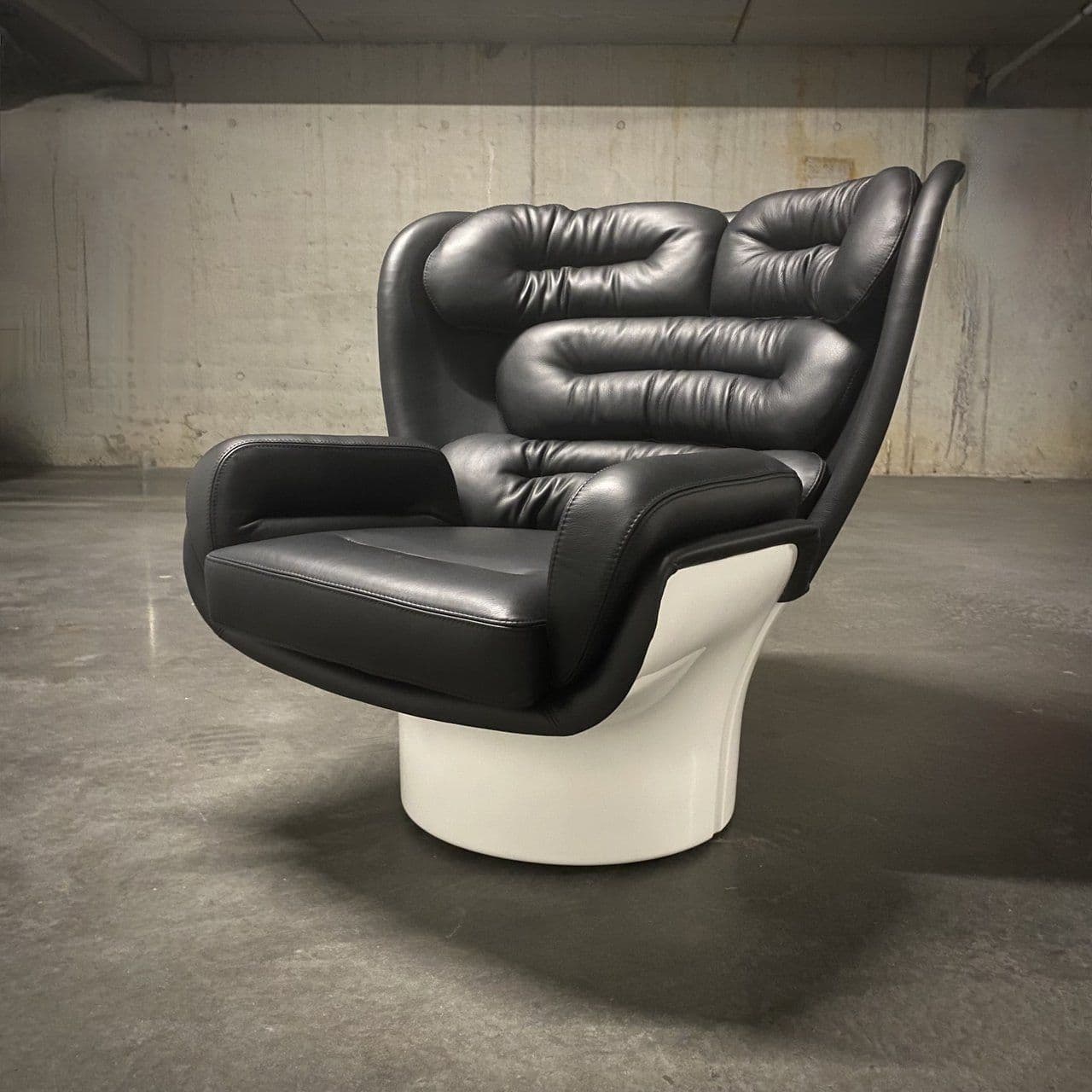
Joe Colombo designed for roughly a decade before he died at 41, yet his Elda chair is an Italian icon whose popularity seems to grow every year, and it is the piece this Whoppah Explores edition starts from: a moulded fibreglass hull with seven removable cushions that rotate 360 degrees, named after his wife Elda and shown at the Louvre and the Museum of Modern Art in New York. Born Cesare Colombo in Milan in 1930, he spent his twenties painting and sculpting, started designing in 1953 and opened his Milan studio in 1962, then produced an extraordinarily vast body of bold, curved, optimistic work, from the Universale, the first chair made from a single material, to futuristic all-in-one living systems.
Who was Joe Colombo?
Cesare (known as Joe) Colombo was born in Milan in 1930. In the 1960s, he was ahead of his time, designing bold and daring objects with a strong optimistic vision. This earned him a place in the history of great Italian designers. Thanks to his energy and optimism, the famous designer produced an extraordinarily vast body of work in a tragically short career. Not only did he die young, at the age of 41, of heart failure, but he began designing relatively late, having spent his twenties painting and sculpting.
Career
Like many other designers, Colombo did not begin his short-lived career as a designer. During his formative years, he took up the fine arts, such as painting and sculpture, and studied at the Academia di Bella Arti in Milan. Joe Colombo did not begin his career as a designer until 1953, when he created a ceiling for a jazz club in Milan, including three outdoor lounges, a project that prompted him to enrol in architecture at Milan's Polytechnic University. He then opened a design studio in Milan to work on architectural commissions in 1962, experimenting with new materials, particularly plastic. During his decade as a designer, Colombo was exceptionally prolific. He created some of the most memorable products of the 1960s: from the Universale, the first chair made from a single material, to futuristic all-in-one living systems. All his early designs have one thing in common: they are bold, curved sculptural forms.
What makes the Joe Colombo Elda chair special?
In 1963, Joe Colombo visited a shipyard that made fibreglass boat hulls. He had an idea: why not use the same technique for the base of a chair? The result: a spacious, futuristic chair in which seven removable cushions can rotate 360° inside a moulded fibreglass hull. The chair became an icon, and he named it after his wife, Elda. The chair can be seen in the Louvre and the Museum of Modern Arts in New York, and Elda appeared in the 1977 Bond film The Spy Who Loved Me, the 1970s series Space: 1999 and the 2012 film The Hunger Games.